

I am not here to make grand pronouncements or rally everyone with, “Come on! Let’s run every day and stay healthy forever!” In the end, these are only fragments of thought, or perhaps questions and answers I pose to myself—what, for me personally, does keeping on running really mean? Nothing more.
When writing this book, the author did not yet know what running meant to him either. He was simply exploring it.
Most of the novels and films I watch are probably like that: they do not put a clear position on display, and perhaps the author did not have a definite answer while creating them either. They were simply exploring.
“An essay is born whole by nature; a deft hand happens upon it by chance.” That perhaps captures this kind of exploration. The more one tries to force an analysis of the author’s “ideas” or an article’s “central theme,” the more foolish it feels.
That is why I used to dislike reading-comprehension questions so much. A good novel begins with so many possibilities, yet a standard answer fixes it within the interpreter’s own limitations.
But I realized that I had recently been trying to do something similar myself. Frightening. At most, I can discuss some problems in my own existence, not analyze the author’s “ideas.” About myself, not the work: that is what I want to do. I could add this to my review criteria.
The wish to be alone has remained unchanged in my heart. So running for an hour every day, to secure a period of silence that belongs only to me, has become an important practice for my mental health. At least while running, I do not need to talk to anyone or listen to anyone. I only need to look at the scenery around me and gaze inward. Nothing can replace that.
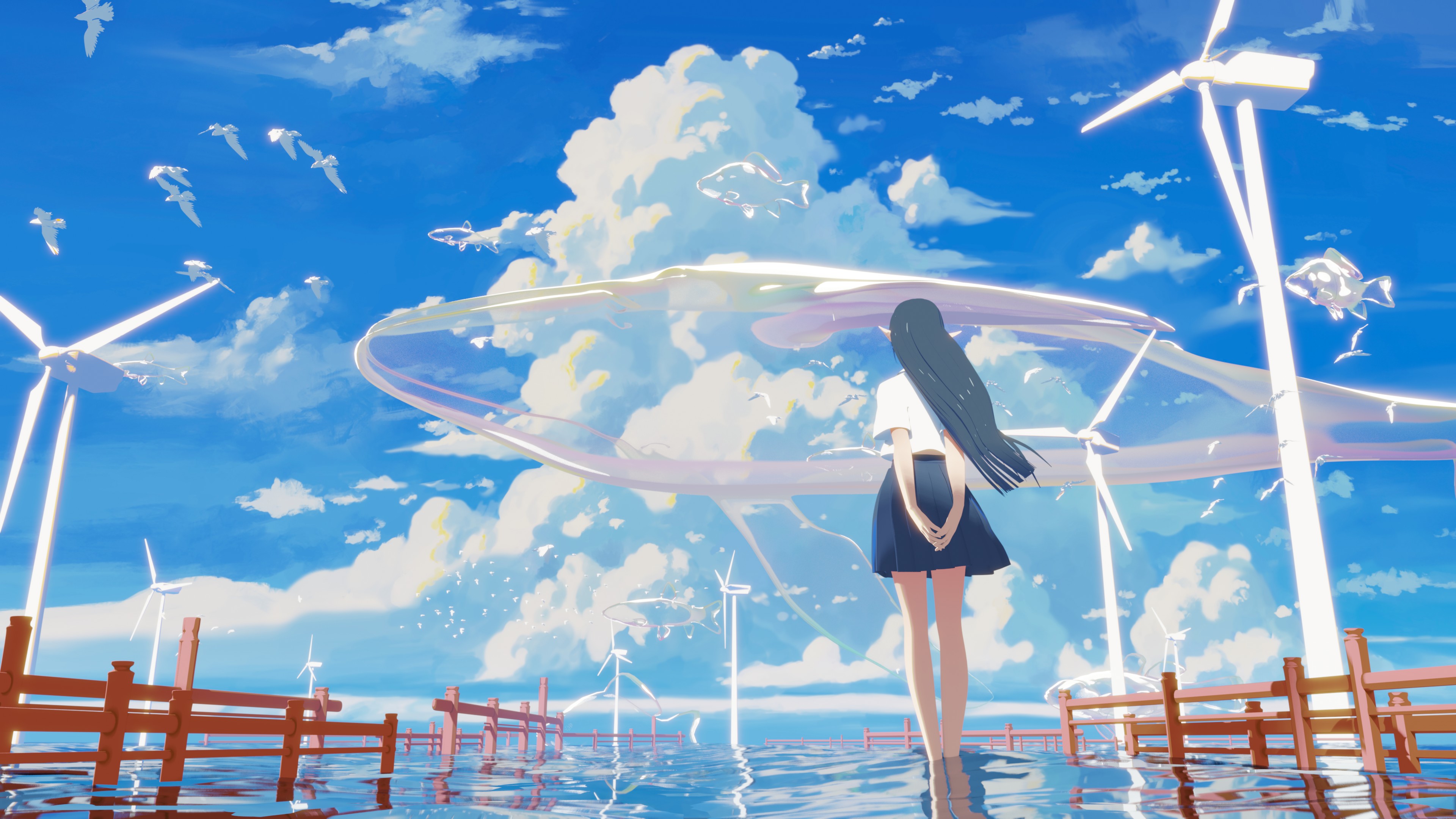
The thoughts that come to mind while running are much like clouds in the sky: different shapes, different sizes. They drift in, and they drift away.
When I run, I always look up at the sky every so often. I used to run around three-thirty in the afternoon, when it was very hot (no sunscreen, no hat—I was brave). The sky changes fastest then: direct sunlight turns into sunset glow, then dusk, then darkness. All of that happens within two hours.
While running, all the “serious” and “important” things seem not to surface in my mind. At first, I only need to care about my stamina, then my breathing. After about half an hour, I may enter a kind of meditative state. I have not experienced that in a long time.
Running feels a lot like meditation, because I often run half asleep, and I am half asleep when I meditate too.
I have thoroughly arrived at my fifties. When I was young, this was unimaginable.
For Murakami, the twenty-first century was unimaginable when he was young. For me, I probably will not get the chance to see the twenty-second.
Before, even the summer after the college entrance examination was unimaginable.
Now, becoming a corporate drone was unimaginable.
We always step across those thresholds without noticing, then feel a little flattered and a little at a loss.
My interest in learning arose after I had more or less completed the prescribed educational system and become a so-called member of society. I understood that, if I pursued fields and things that interested me at a pace suited to myself and with methods I liked, I could master knowledge and skills extremely efficiently.
People who teach themselves almost always become experts, while those from the “academic school”—or those deliberately cultivated and guided, with everything set out on the table for them to consume—often become lost at a certain point and feel unable to make further progress.
I have tried to leave teachers’ systems behind and study on my own, yet I run into problems too: motivation and feedback. Some people learn because a project requires it. That kind of learning is tiring, but they can quickly and clearly tell how deeply they need to learn. Still, I admire people who are interested in knowledge and technology themselves more: no comparison, no goal, only pure curiosity.
When I ran a bar, I followed the same principle. Many customers came in. If one person out of ten said, “This place is good. It suits me. I will come again,” that was enough.
I care more about my own feelings; the people who stay do not need to be many, only sincere.
I try to write my blog and journal with that feeling. I think it is better for me that way, just as fishing alone is better for Arthur Morgan.
Even if the amount of practice declines, do not stop practicing for more than two days. This is a basic rule for building mileage. Muscles are like animals with good memories: as long as you increase the load gradually, they naturally adapt to and bear it.
When I run continuously, one day of rest feels like an unexpected blessing. But by the next day, laziness has already begun to show. It is not only my muscles slackening off on their own; my thoughts easily talk me into never going out to run again, and then I gradually become comfortable lying down.
Besides talent, if I had to name an important quality for a novelist, I would unhesitatingly name concentration. It is the ability to gather the limited talent one possesses and pour it into the place where it is most needed.
After concentration, endurance is essential. Even if one can concentrate on writing for three or four hours a day, if one keeps at it for a week and then says, “I am exhausted,” one still cannot write a long work.
Fortunately, unlike talent, concentration and endurance can be acquired through training. Their capacity can be continually improved.
When I am extremely idle, I always get up early, read novels and comics, and keep reading until lunch. But I have also had stretches of getting up in the morning and concentrating on one thing: programming, blogging, writing fiction. For a time, I truly felt my focus visibly improving.
But eventually that growth turns into self-doubt. Every morning feels the same, as if I have fallen into a time loop. Then I stop in retaliation. Breaking a habit feels refreshing at first, but after my brain adjusts to the high dopamine, another kind of boredom sets in.
I still do not know which way is right or how to spend my mornings. But I think it is necessary to change things every so often and leave myself appropriate “rest days.”
Running is undeniably captivating: within one’s individual limits, one can burn oneself effectively—even if only a little. That is the true work of running, and a metaphor for living.
I hope to keep running regularly. I hope to keep the habit of focused mornings. Not to keep improving, but as a kind of resistance—to remind myself that I exist in the present and help me better recognize my current situation. To feel grateful for leisure instead of getting lost in aimlessness and boredom.
At a point when you feel you could keep writing, decisively put down your pen. Then it will be easier to get back into the flow when you begin again the next day. —Hemingway
I will go running tomorrow, and if I can, I hope to do the same the day after.
- 9 collapsed above
- 10After The Poppy
- 11Pandora's Box
- 12Reading Notes on Rashomon
- 13Sahara Stories: Reading Notes
- 14A Maverick Pig
- 15What I Talk About When I Talk About Running: Reading Notes· current
- 16Imouto Life
- 17A Snow Rabbit Twenty Centimeters from Spring and The Shawshank Redemption
- 18What Bad Intentions Could I Possibly Have?
- 19The Lychee of Chang'an
- 20Filled with Empty Things


